Wild Honey Records Release Free 2026 Sampler
Wild Honey Records is still run the same way it started: out of a garage, non-profit, no contracts, and a…

As I sat backstage at the Edmonton Event Centre across from Tom DeLonge and David Kennedy of Angels & Airwaves, I couldn’t help but feel that everything has come full circle. Blink-182, DeLonge’s other band, was the first band that got me into the whole punk rock thing as it introduced me to a style and sound that forever changed my life. Not to mention the fact that my first web site was also a Blinkfan site which in turn opened up more doors for me than I ever thought possible. David Kennedy, oddly enough, was the first person I ever interviewed as in 2002 I conducted a phone interview with the thenBox Car Racer guitarist. The interview wasn’t fantastic due to my inexperience but started me on a long road of interviews.
But this isn’t about me, this is about the two guitarists and their latest endeavors in Angels & Airwaves. The band’s been busy. Not only did they self-release and self-fund a new album which they’re giving away for free online but they’re also working on a feature length film of the same name which will be released later this year. We had an indepth look at both of those, along with the philosophy and ideology behind Angels & Airwaves – what they’re trying to accomplish and why.
Over the course of the interview we touched on many aspects; sadly, due to time restraints, we couldn’t go into tons of details about everything but instead had a nice overview so if you ever get a chance to talk to the band ask them about the esoteric symbolism of Love, the importance of technology in today’s industry and definitely get Tom talking about aliens and UFOs – something I think he could talk about for hours if the rest of the band didn’t cut him off.
Bobby: Starting with the basics, you guys are around a week into this tour with Say Anything. How’s that going so far?
Tom: Oh it’s good man. We’ve been really looking forward to this. We’ve been rehearsing for quite a while. We’ve been working on the record for well over a year so to get out here and play the shows, there was a lot of anticipation and excitement building up. So to finally do it, it’s like we’re finally off to the races here.
Bobby: Like you said, you’ve been working on Love for quite a long time. Originally it was supposed to be put out on Christmas of last year and then it got pushed back until Valentine’s Day. What was the reasoning behind the delay?
Tom: You know, we write songs very differently than a lot of bands. So our times lines always seem to get kind of skewed a little bit. A lot of bands, in my experience, rehearse their songs and then go right into the studio and the record them like a factory line. Because what you don’t want to do is stay in a studio for a long period of time because it’s very expensive. So you want to be well rehearsed, get in there and get it done as quick as you can.
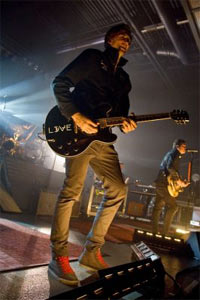
We don’t do it that way. We use all the tools and electronics around us and we take one idea and we evolve it into something like what you hear on the record. So to do it that way where you’re bouncing around between songs and working on different ideas in any given day, it ends up prolonging the process but you get a much better album that way I think. Therefore we weren’t anywhere near close by Christmas. We literally finished the record the night of the thirteenth; twelve hours before we launched it or something.
David: Yeah, the mastering came back and it got screwed up so we had to re-master it. Friday we pre-released with Fuel TV so that Wednesday, the tenth, we had gotten the mastering back. They were done mastering and we said it was okay, but then we went home and listened to it and said it was not okay on Thursday. Literally, like hours beforehand…
No one had it before, it was the first time ever where a record got put out for us – anything that any of us have been a part of it – where it never leaked; press, kids, our friends and families hadn’t even heard it before we actually put it out.
Bobby: There was no time for it to, only a day’s notice isn’t enough time for it to leak.
David: Absolutely. So we thought maybe it was genius.
Bobby: You guys did, of course, release the CD through Modlife for free online; but you also mentioned that you were planning on releasing a limited deluxe edition, a physical copy, to sell on iTunes and in stores for five to ten bucks. Do you have any details on that?
Tom: That’s still the plan. I think we would’ve liked to have done that earlier, we just did not have the time. We don’t have a label or anything, so we’re doing everything ourselves. So there was just not any time. Every single person in the band was working non-stop to make the record what it was. But I think what is probably more doable is to have that version come out with the movie. I think that would be a really good benchmark for us and I think that’s something that we could pull of. So I think, if I’m not mistaken, that would be something worth kind of saying now that when the movie’s comes out – in the theatres or on DVD – we’ll have that other version.
David: That’s the next point that we have. At this point if we put it out there, we’d just be putting it out just to put it out. So if we partner it with the movie, than it’s actually like a real platform thing.
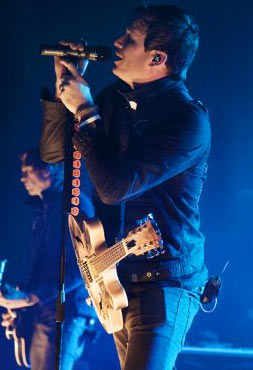 Bobby: Like you said you’re not on a label right now because you had to leave Geffen to do this because when you wanted to put it out for free there were some costs that Geffen didn’t want to sweep under the rug. So why were you so adamant that you had to put it out online for free?
Tom: Because we can’t grow on a major. I don’t know any – maybe the Kings of Leon are the only rock band that’s done big.
David: In the last couple years.
Tom: In the last few years I can’t think of any rock band that has really had a lot of success on a major label. So you’re kind of stuck when you’re on a label. They’re trying to sell something but block people from getting it unless they buy it but people don’t want to buy it, they’d rather just get it.
David: Or they just buy one song.
Tom: Yeah, or they just buy one. It’s worked out really well for us. Everyone got the entire record and it didn’t leak and there’s no limit to how many we can give away. We never have to stop pushing it either. We can come up with as many ideas as we want to give it away and it’s exciting.
Bobby: Now I’m relatively certain that you guys are kind of a hot commodity and I’m pretty sure Geffen didn’t want to just let you go. How hard was it to get out of the deal?
Tom: Yeah, it wasn’t easy. We had to do some negotiations. You know, as nice as it was that you said that, I don’t know if we really are a huge hot commodity for a major label like Geffen – and it’s Interscope now by the way – where most of what they do is hip-hop related. They don’t have much they can do with a rock band. I mean, one of the guys, a famous thing they said, they said – [looking to David] what was Rick’s quote? “There’s no place in music for a white guy with a guitar.” That was said from the label.
David: They’re focused on Pussycat Dolls and it became more and more apparent that rock and roll was just a thing that they had to deal with.
Tom: I mean they like rock and roll. They’re all rock and roll guys.
David: But it’s a business.
Tom: They’re businessmen and they’ve got to run a business; and rock and roll isn’t selling.
Bobby: You said that with the album you teamed up with Hurley and LiveNation and Fuse TV, to send out the links to a combined list of fifty-five million people and you hoped that you would get around twenty million people to download. How…
Tom: That’s the life of the record. Life of the record. The life of the record might be a two-hundred year life, so over the next two hundred years…
No, I think what we’re shooting for… What that means is that we partner with a lot of companies, for example, LiveNation – just LiveNation – sends out thirty-five million e-mails.
David: But the truth is it didn’t go all out. It’s still going out. That’s the total mail out.
Bobby: It’s still scattered.
Tom: Yeah, and it’s with other things on the e-mail; it’s not just us.
David: It’s not like they just send out a thirty-five million database list out. It’s spread out over news as we start coming, as there’s something happening. It’s spread out; no one’s just going to blast it.
Bobby: So like you guys are coming to town and LiveNation is putting it on, to help promote the show they’ll send an email out to download the album.
David: Right, right.
Tom: So the way it works, for example too, you add up all these companies and then you also have… like when we put our movie trailer up on Apple Trailers, we had two million people view that trailer within the first, shit, within the first two or three weeks or something crazy like that. I got the results back from the guy at Apple. So the thing that we would’ve love to have done – but that came out before the record was done – is that you could’ve downloaded the record right there with the trailer. That would be two million downloads.
But we have a lot of work to do. We have things we want to do, we have things that we’re dreaming about, and we have things that we haven’t done yet that’s part of the plan. I don’t think it will be that difficult to have millions and millions of people get the record over time, you know? A goal of ours would be ten to twenty million, that would be a rad goal and only because when you look at the amount of people that have interest in what bands like us are doing, all you need to do is be able to knock on their door and see if they’re willing to take a chance.
What we tried to do is create a system where there’s no money needed, there’s no e-mails needed, you just click it. But also what we want to do is create a bunch of reasons why someone would be interested in us, not just for the music but things like the message, things like the film, things like the iconography and the symbolism and everything. There’s a bigger picture here. So if there’s one of many things you’re interested in in what we do, then you might download the record. So just to confirm with that or restate it again, I still have that goal of tens of million people getting that record.
Bobby: Well you did get half a million within the first forty-eight hours, so that’s pretty good.
Tom: Well not the first forty-eight, in the first few weeks.
David: But there was over three-hundred thousand in the first few days. It was a lot.
Tom: There’s a…[he chuckles] It makes me laugh because there’s this company called…
David: Big Champagne.
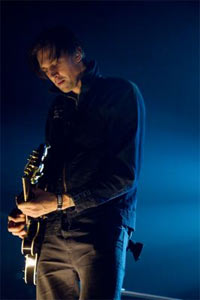 Tom: Big Champagne that tracks file sharing. So if someone grabs it from the Angels & Airwaves site, we know how many that is. Big Champagne tracks it if you were to take it and give it your friend where we don’t even know how often that’s happening. We were able to look on our other records what was happening. Within like one week there were three hundred thousand file shares of I-Empire and that was two years after that record came out. So we think that there’s a potential… we know that there were half a million that came from our site, but we think it could be double or triple that – maybe even more – we don’t know. But technology’s really interesting. You can do things like that.
Bobby: Yeah, and with Modlife and all that stuff too, there’s a lot of opportunities there.
Tom: That’s the idea. We’re just trying. We’re a small band, we’re just trying to figure it out because a new way needs to be figured out.
Bobby: I also want to talk about Love, the movie, a little bit. First off, what do you have planned for it? Is it going to be straight to DVD or limited release through Lions Gate or what?
Tom: We’re thinking theatres. I don’t know how many theatres. You know what? The independent film industry is very much like the rock and roll industry – it’s dying. So it’s a very, very hard thing to do – to make a movie and get it in theatres. We actually have more options than a normal independent film does because we have a built in audience, you know? But our hope is to be on a certain amount of theatres, absolutely. It’s made for that. Obviously it will come out on DVD; it will be sold to television – all those different ways. I can’t really tell you anymore until July when we’re finished; because that’s the plan – to be finished around July.
I can tell you, honestly, the movie is ten times better than I thought it would be. But it’s not meant to compete with Transformers. This is an art-house film and no band has really done this in a very long time. So we’re hoping that we catch some people off guard and we’re also hoping that we do something that is very credible as far its artistic acumen goes.
Bobby: The movie was originally called I-Empire and was supposed to use I-Empire as a soundtrack.
Tom: Absolutely, yeah.
Bobby: At what point did you realize “I-Empire’s not going to work; we need to record something else?”
Tom: Well, what happened was we set up these ideas about what we wanted to do for the film. We hired the director, we set up a big kind of overall reaching message and tonality and parameters for what the film would be. Then we shoved the director off on his maiden voyage and he goes out. Well he comes back two years later and we’re all thinking it’s going to be finished, we’re gonna wrap it up, we’ll let it come out with this record; and when we saw it, it just blew us away. We couldn’t believe what he did. But we also knew that it wasn’t finished yet – it needed more.
So we made a decision to clip the idea of it coming out that year and really re-invest in it and take a big swing at the fences – forgive the baseball term for people that might read this in different countries – and try to have it come out with a free record. This will be our big moment to have a hundred percent independent release. Not only with the film and the music and album or whatever, just a very DIY – do it yourself. And show what could happen if you work your ass off.
Bobby: Was there a change in tonality or concept of the movie from you having to go from I-Empire to Love?
Tom: No, that’s the funny thing. It evolved, it grew; but the tonality of the film was always going to center around the story of a few different individual’s lives. The way we ended up tying it all together definitely grew into a much bigger picture; but that’s no different than writing a song. You always think you know what the song’s going to be and then once you start recording, it grows.
David: The base of our band hasn’t changed. I think ultimately it does work with whatever record. The songs change but the message and the purpose behind it always remain the same, the foundation. So it’s still going to be applicable to whatever we do.
Bobby: The movie was written by the director William Eubank who was the DOP on Nicholas Cage’s Knowing.
Tom: I don’t know if that’s true. He didn’t work with Nicholas Cage. He didn’t work on Knowing did he?
 David: I don’t know even know what the fuck you guys are talking about. I really don’t. What movie is that?
Tom: Knowing, that Nicholas Cage one.
David: Oh, Knowing; he didn’t work on that.
Tom: Yeah.
Bobby: Oh, it’s on his Internet Movie Database page.
David: Really?
Tom: He doesn’t do that. That could just be the site itself. IMDB is an automatic kind of deal. He’s done a lot of work though.
David: He started when he was a kid.
Tom: We hired him when he was twenty-three. So I guess he’s moving on to twenty-seven now.
Bobby: Still, you guys have been working on this movie for a long time but William’s the one who ended up writing the script. So who came up with the idea for the plot of the astronaut in space?
Tom: We all did, the band and the director together. We had to set up things like what the tonality was, the look of the film, the aspiration and ambition of the storyline; but we’re not cinematographers so it’s not like we told him exactly what we want it to look like. We embraced his art and you have to.
The difference between a film and an album is as a band we can go make a record. But when you make a movie, you need like scores of people to do different things. There’s no director that I’ve ever heard of that can do his own sound design. There’s no director that I’ve ever heard of that goes and does his own special effects and CGI. It’s like…
Bobby: You need help.
Tom: You need help because you might film everything but there’s no sound. Film has no sound. Those cameras don’t record any kind of audio whatsoever, so you need a team of people to record sound. And then you need a team of people to fix that sound and then you need a team of people to add in the sound of the cars and the buildings and the fucking whatever – the weather, the storm. So that’s how we approached it. We have to, as producers of the film, put up a large level kind of infrastructure for it and then the other guys plug in and do the things that they’re good at.
Bobby: When I saw the trailer for Love, there was one scene in it that automatically made me think of 2001: A Space Odyssey which is obviously something you guys were going for because I know in an interview with Billboard you said you wanted to have a Stanley Kubrick type of feel to it.
Tom: Yeah, yeah, we love him.
Bobby: Why did you decide to try and have a Stanley Kubrick feel to it and what other influences were you trying to get into it?
Tom: Well the band, I mean, we all love Stanley Kubrick but the director loved him too. I think it was definitely something that we met eye to eye on. I fucked up in that interview because I said things in the wrong way because I think out loud and I should probably know by now.
I mean, obviously Stanley Kubrick’s not around anymore but he’s one of the greatest – top three probably – filmmakers of all time. So it’s not like we’re thinking that we’re going to do what he’s done. But I think that to aspire to film things, to think the way he thinks is what all young artists do when they look up to their peers. Will looks up to Kubrick. He understands what Kubrick would do as a director and he would try to implement some of those tools. So that’s what we were going after with the film, to basically learn from some of the great heroes like him.
Bobby: Space, as an overall theme, has always been very important for Angels & Airwaves. From the name Angels & Airwaves to the artwork – We Don’t Need To Whisper with the world in the box, I-Empire, the Star Wars influenced cover on that. Why did you decide to go for the space theme in Angels & Airwaves?
David: I don’t know, you’re always looking up. So it always seems like in looking up into space, there’s an endless amount of possibilities. So it seems like it’s the best thing to start from that. There’s no expectations too because it’s the unknown.
Tom: No one knows what’s out what there. It’s undefined.
David: And that’s what Angels & Airwaves was supposed to be. I think we wanted something that people couldn’t necessarily define but were intrigued by and I think that’s very well represented by space.
Bobby: The song Lifeline on I-Empire – I read that was the first song that you sung sober after being on the pain medicine for your back. At what point did you realize “I’m addicted to these drugs. I gotta get off them?”
Tom: A long time ago. I think anyone that does things like drugs or alcohol; you know it a long time before you admit it to anyone. You know when you wake up in the morning and your body aches for it and you can’t get through the day and you can’t get it off your mind. So I knew that a long time ago and like anybody else, you need a specific type of shove to take that big step. So that record, a lot went down on I-Empire. That was really crazy.
David: That happens with every record though.
Tom: I know.
David: Every record’s been hard for us.
Tom: [laughs] I know it has too, but we’re gonna win somehow! [laughs]
Bobby: The movie will be easy; you’ll just get that out and it’ll be smooth sailing from there.
Tom: Yeah, I wish. That might be one of the hardest.
David: It’s too late for it to be easy. I don’t even know how it got this far.
Bobby: I want to talk a bit about the thematic progression of Angels & Airwaves, or at least how I interpreted the thematic progression.
Tom: Sure.
David: I’m excited to hear this.
 Bobby: To me, We Don’t Need To Whisper is more introspective, looking at yourself and changing within with songs like The Adventure and A Little’s Enough; whereas I-Empire’s more looking outwards and constructing a world around you, letting your imagination soar with Everything’s Magic, Secret Crowds, Love Like Rockets and Rites of Spring. With Love, to me, it’s more like an examination of relationships. The relationships between you, your friends, your loved ones, complete strangers and god. That’s how I kind of interpret it.
Tom: Wow that was great. Pretty good.
Bobby: How would you guys interpret your thematic progression?
Tom: I honestly could not say it any better. I mean, that’s exactly how it was. Whisper was very introspective. It’s trying to figure your place in this world and trying to imagine a new world. I-Empire was really all about going out and grabbing it. To stop kidding around and acting as if you need it brought to you, go out and take it. That’s why on the cover there’s a guy with a motorcycle on it, on a long highway with his flags – it’s like he’s about to go out and take his own territory. Love really is about the definition of your relationship with life, people, god, the universe – whatever that means to you; whatever your version is of all those things.
It’s also a study in esoteric symbolism which is basically a series of shapes that draw an energy out of a human being. That’s why we wrote the word Love in a very different kind of way. Because there’s a mystery to it; so when you look at it, you know what it means but you don’t know the way we think it means. Love, there’s not much about it the way we say about boyfriends and girlfriends. It’s a much bigger kind of concept to us – which includes that, but much more ambitious.
The way you said it was absolutely right and I appreciate the fact that you picked up on that, that makes me feel good you know?
Bobby: Speaking about the definition of love, I was reading a review of the new album, Love, which kind of stuck out of my mind because he pulled a quote from The Mark, Tom and Travis Show where Mark turns and asks you “do you know what the best part of falling in love is?” And your response is “the sex.” Now, of course, based on Love, the album, your understanding of love has obviously changed a bit. So now what would you say the best part of falling in love is or how would you define love now?
Tom: Ah, that’s a good question. I think the best part of falling in love is the fact that something inside you – that a lot of people would call the soul – feels connected to something else, like a true connection. A lot of our movie and what this album is about, and Will Eubank really was the first one saying this out loud, that the movie to him was all about “what are you if you have no connection?” Because largely the movie is about an astronaut that’s stuck in space by himself and he doesn’t understand why. I think when you fall in love with another human being you have this indefinable connection that’s more of an energy and more of a consciousness kind of thing that a lot of poets have been trying to put into words for a long time. I think the joy of it is you can’t read any words that make you understand it necessarily until you have it in your life, and then it’s pretty amazing.
Bobby: Just a few more quick questions. One thing, kind of going hand in hand with movies and the whole space thing because I know that you’re a conspiracy buff and you’re a firm believer in UFOs and aliens which you kind of hinted at with Aliens Exist where you referenced the Majestic Twelve. So my question is have you see the Milla Jovovich movie The Fourth Kind?
Tom: Yeah, yeah.
Bobby: What did you think of that?
Tom: I thought it was amazing. I was sad to hear that it was all fake but I do think those things happen. I think it ties together some really interesting stuff. I think it was an extraordinarily fun movie because those type of things that people; it’s a terrifying experience for a lot of people that come in contact with that kind of thing.
It’s funny too; the way I felt when I was younger to now has changed so much. I’m always trying to press my new data upon my band members here.
David: [laughing and calling over to bassist Matt Wachter] Yesterday Matt when you were sitting in the back lounge and he fucking sat down with that book [Tom and Matt burst out laughing] you turn to me and [he mouths the words “help me”].
Tom: He’s like stuck.
David: I started walking away and I look back at Matt and [he gives the finger or does something making fun of Matt for being stuck with Tom; I forget exactly what he did and the action had no audio to be picked up from the audio recording. Everyone bursts out laughing.]
Tom: You’re such a dick! Hey, you know what…
David: There’s always this moment where Tom goes “see dude, it’s just like this.” And he has a book or something and you’re like “awwwwwwwww.”
[At this point, Matt, David and Chris Georggin, their manager, all start talking over one another, laughing and making fun of Tom for his alien conspiracy ways].
Tom: Hey, I’m just trying to figure it out man, that’s all I’m trying to do. If you want me to hold out until I know and just tell you when I’m done.
David: No, no no.
Matt: [laughing] No, please go on.
Tom: I could bring you along for the ride. What if one day I wake up and I just go “okay, this is it.” I got within five percent of knowing it all and went back down. [Matt laughs like crazy in the background] See, this is what pisses me off. Two cops lied about it. I thought that could have been legit. But dude, there’s this chick…
David: [Cutting him off] Oh god. Do you have another question?
Tom: Okay, fair enough. We don’t have time.
Bobby: Just a quick Blink question. I was wondering if you knew when the Blinkumentary was going to be out?
Tom: Actually, I don’t know that answer.
Bobby: Awesome, thanks a lot. Do you have final thoughts you’d like to add?
Tom: No. You did a great interview man, I appreciate it. I really want to thank you for looking into the meaning of the album and all that stuff. It makes me feel good because we put a lot of work into that kind of depth and if anybody can figure that out, it makes us stoked.


The Arrow Room, Rancho Cucamonga, CA - 29th March 2026

